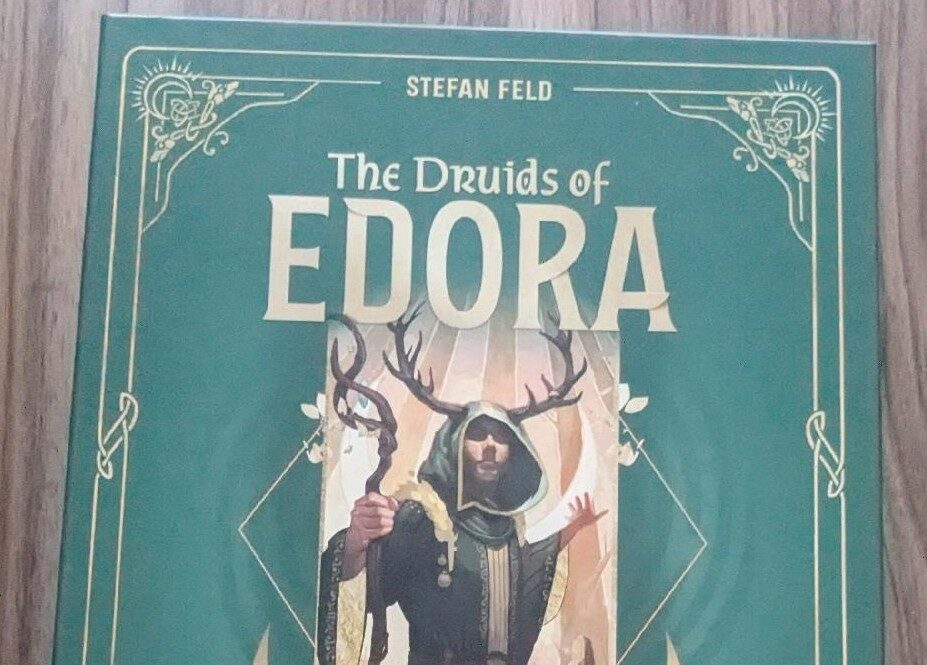
The Druids of Edora
Every review on Meeple Cove is written after exactly one play. No replays, no second sessions — just an honest account of how a game landed the first time we sat down with it.
The reason is simple: there are too many games to play. New releases come thick and fast, and the pile of unplayed games on the shelf never gets any shorter. In that reality, most games only get one shot at the table. If a game takes two, three, or four plays to reveal its strengths, it may well be a great game — but if that first play didn’t grab us, the chances of it making it back to the table are slim. We don’t need to love a game immediately, but if it’s the kind of game that needs multiple plays to click, we need to be able to see that potential in the first session. We’d rather not invest three or four plays only to find it wasn’t for us after all.
There are plenty of reviewers who play games many times before passing judgement, and if you want a deeper, more considered take on a game’s long-term merits, they will serve you far better than we will. But that’s not what this is. This is one play, one verdict — an honest reflection of how many people actually experience a game. Our conclusion isn’t whether a game is objectively great or not. It’s simpler than that: would I play it a second time?
Introduction
The Druids of Edora is the latest design from Stefan Feld, transporting players into a mystical forest filled with shrines, dolmens, standing stones, runestones and potions. While the theme sounds rich on paper, the game is fundamentally a Euro about resource management and timing your actions efficiently with various sub systems resulting in many different paths to score Prestige points.
Players move around the forest, paying provisions to placing their dice on shrines and choosing one of the available actions. Each player has thirteen dice, placing each of them once per turn and the game ends once a player has placed all their dice on the game board.
A four player games took around 2.5 hours including the teach and we would expect this dropping to c.90 minutes on subsequent plays.Text here
Setup & Teach
Physical setup is reasonably straightforward considering the amount of information packed into the game. The main board comes as a modular jigsaw (similar to Civolution – another Stefan Feld game) which assembled randomly results in some variability in the board state from game to game. Once the board is assembled and everyone understands where their personal resources and dice are stored, getting started is relatively quick.
The teach itself isn’t particularly difficult, but the rulebook is poor with several sections leaving ambiguities which I believe are due to translation issues. We only avoided potential problems because we had known about the rules ambiguities beforehand and checked on forums beforehand. Fortunately, once the game begins, the underlying systems are very intuitive and pretty simple.Text here
Gameplay
The most novel aspect of the game is that all thirteen of your dice are rolled at the very beginning of the game. Four begin in your personal supply while the remaining nine are stored in a general supply and actions can be taken to move the into your personal supply. Unlike many other dice-driven games, there is very little opportunity to manipulate these values, and you are largely committed to the values at the start of the game (there are some potions and herbs which allow you to manipulate dice values). While dice naysayers will moan, I personally think this is a brilliant mechanic and this input randomness actually creates an engaging strategic puzzle (more on this later).
On your turn you will move your playing figure to a shrine and place a die on an action square on a space paying provisions to do so which will be dependent on the distance travelled and the value of the die placed. If there are other players’ dice on that shrine, the player with the highest value dice gets 2 Prestige (with ties determined by whoever is highest on the knowledge track) – (this is referred to as “Competition” in the rulebook – how dull!)
There are eight types of action spaces on the map:
Take 3 dice OR 12 provisions – Replenish the two resources that drive the entire game. Dice provide future actions, while provisions pay for movement and die placement. Taking provisions is simple (and believe me 12 provisions don’t last you long!) but the taking 3 dice is really interesting. This is where strategy and tactics begin to merge where you will know (hopefully!) what you overall aim is in this game but you need to pick 3 dice which blends into what you plan to do in the next few turns depending on where you are on the map, where you want to go, and how many provisions you have and how many you will need.
Advance on the Knowledge Track – Increase your position on the knowledge track which will act as tiebreakers for Competition as well as multiplier for end game Prestige.
Move your Sickle – Progress along the medicinal herb track, unlocking herbs that provide ongoing abilities which improve the efficiency of future actions. This has a clever mechanic where there are 12 types of herbs each representing a different power. These herbs are released in pairs as you move up the track and each time a pair is released, you have to activate one (which gives you that ability/bonus for the rest of the game) and deactivate the other one (and hence not being able to utilise that ability in this game) – lovely decision-making!
Take a Stone Tablet – Claim an end-game objective that can be worth 10VPs if its conditions are fulfilled. You also gain 2 small bonuses.
Gather Mistletoe and Brew Potions – Collect mistletoe and convert it into potions providing powerful one-off effects, ranging from extra resources to scoring opportunities.
Add a Gemstone to your Amulet – Place gems into your amulet to unlock immediate bonuses and gain end-game scoring.
Erect a Standing Stone – Add a standing stone to the shrine gaining the reward associated with that stone as well as all the rewards of all previously placed stones.
Erect a Runestone – Place a runestone on the shrine for a reward that scales with the value of the die used – this is the only action where the value of the dice affects the power of the action.
What makes these actions compelling is how interconnected they are. Improving one area often enhances the effectiveness of another. And you don’t need to do everything – but you probably will do nearly every action at least once – mainly since you will get to a point where you will find a particularly juicy opportunity to gain oversized rewards or (more likely!) you desperately need dice or provisions and will do an action just to get the bonus dice/provisions. The result is a web of interconnected incentives that encourages specialisation while still leaving room to adapt.
The two other main in-game mechanics involve firepits and dolmens.
Firepits are scattered around the board and once the first player who places their dice on all the shrines surrounding the firepit will gain the bonuses printed on the firepit.
Dolmens provide another subtle but important source of points. Around the edge of the board are pairs of coloured dolmens which are placed at the start of the game. During the game, players can create routes connecting matching coloured pairs by forming chains of their dice across the map. When a connection is completed, prestige points are awarded based on the length of the chain, with additional bonuses available for the first few links completed during the game. What I like about the system is how it gives lower value dice a meaningful purpose. While high dice are often competing for shrine majorities and end-game scoring opportunities, smaller dice can be used more efficiently to build routes and claim dolmen points. It creates another strategic avenue that rewards planning ahead and territorial positioning rather than simply chasing the most powerful actions.
These systems help drive competition across the map, giving players objectives beyond simply selecting the strongest action spaces.
The one last critical piece is that if a player is unable to take a turn due to not having any dice or not having sufficient provisions to move to a shrine, they will be forced to take a “Druid in Distress” action which involves gaining a die from their supply and 6 provisions. With careful planning players should be able to avoid this – however in our first game three of the four players had to take this action at least once.
The game ends when any player has placed their 13th die and once the round has been completed you move to final scoring.
You will score for various things – however a key scoring point here and another clever design is the shrine scoring. You will go through each shrine and remove all the dice apart from the highest value. Then the player whose dice remains will take their dice and all the standing stones and runestones that were erected during the game on that shrine (which may have been placed by a different player). These will then be multiplied by a multiplier based on how far that player has moved up on the knowledge track.
When you put all this together, you can see where the dice roll at the start of the game becomes so interesting. Low-value dice are easier to deploy and often lend themselves towards strategies involving dolmen links, medicinal herbs, and potion development. Higher dice will lead to winning “Competitions” and runestone/standing stone scoring at end game (with associated knowledge track movement). But most games will give you a mixture, and a large part of the challenge lies in determining the order in which those dice should enter play and how best to leverage the opportunities they create. Multiple avenues feel viable from the outset, and the opening roll subtly nudges players towards different priorities without ever locking them into a single strategy.
In all our game, the early game focused on claiming territory around the board and establishing positions around fire pits. As the board fills, however, interaction ramps up considerably. Shrine majorities become increasingly important, competition for the strongest action spaces intensifies, and players begin disrupting one another’s plans simply by occupying key locations first. The board starts out feeling open and opportunistic before gradually transforming into a much tighter contest over space, timing, and influence.
One aspect that initially appears minor but proved surprisingly important was the knowledge track. During the game, advancing on the track mainly helps break ties for shrine majorities, which doesn’t feel particularly exciting. However, its significance becomes apparent during final scoring, where it acts as a multiplier for shrine control. Players who ignore the track can find themselves leaving a substantial amount of endgame scoring on the table, making it one of the easiest systems in the game to underestimate.
Resource tension is another highlight. Provisions are brutally tight throughout the entire experience. High-value dice are powerful but expensive, and you’ll regularly find yourself debating whether to play an efficient low die or a stronger high die that you can barely afford. Eventually everyone runs short of either provisions or available dice, forcing turns spent replenishing resources. These turns can feel inefficient because they rarely generate immediate points, creating the impression that opponents are advancing while you’re treading water. Of course, everyone faces the same challenge and discovering ways to build a more efficient provision or dice economy becomes an important strategic goal. The game constantly asks players to balance short-term efficiency against long-term reward.
Despite the density of systems, turns move surprisingly quickly. Decisions are meaningful, but most are framed clearly enough that players rarely become bogged down in analysis. For a game with this many interconnected mechanisms, the pace is impressively brisk.
Likes
- The biggest strength of The Druids of Edora is the number of viable paths to victory. Based on your initial dice distribution, the board state, and the opportunities presented by opponents, multiple strategic approaches feel competitive. It immediately creates the desire to play again and explore different openings and different combinations of systems.
- The game also moves remarkably quickly for its weight. There is plenty to think about, but most turns are concise and easy to execute. Downtime remained low, with only occasional pauses when someone needed to carefully calculate a complicated sequence of actions.
- Most importantly, the game consistently presents interesting decisions. The combination of route building, majority contests, resource management, and engine development ensures that every turn feels meaningful without becoming overwhelming.
- The interaction is also worth highlighting. Players are constantly competing for shrine majorities, racing for fire pits, contesting routes, and claiming key action spaces, yet the game never feels particularly mean-spirited. It’s interactive in a way that creates tension rather than frustration.
Dislikes
- The rulebook is unquestionably the game’s biggest weakness. Several sections are poorly organised and certain interactions are left unexplained or ambiguous — issues that feel like they should have been caught well before publication. We only avoided problems at the table because I had researched known ambiguities beforehand. It’s a poor first impression for a game that, once running, is remarkably intuitive.
- Some presentation choices feel like issues that should have been identified during playtesting. The score track lacking printed numbers is a strange (shocking?) production decision, especially for a game with a combination of in-game and end-game scoring.
- The gemstone allocation on the scoring board is poorly explained and creates unnecessary confusion. Meeple Cove Tip: In Step 7 of the setup it states, “Sort the twenty-four gemstones and place the six piles on the six corresponding fields on the overview board.” Don’t do that. Instead give each player one of each gemstone to put on the side of their player board. During the game, when they take that action, they should move one of them to the player board. Apart from not having to have tiny fingers, the rules state that a player may only have one of each type of gemstone and this way you cannot mistakenly take another one or spend time trying to figure out which one you have and have not taken.
- There is no theme. When dice are called “Dice” and the character moving around the map is called “playing figure”, you know there wasn’t a huge amount of thought put in. I am not one to care massively for theme so not an issue for me but one to be aware of.
- While the artwork is attractive, readability occasionally suffers. Identifying clearings and understanding the geography of the board is not always intuitive. A stronger visual distinction between regions would have improved usability without sacrificing aesthetics. Given the theme is so pasted on maybe islands with water around it would have allowed a better delineation.The
Verdict
The Druids of Edora is an excellent medium-weight euro that delivers. There is meaningful player interaction without ever feeling mean and the fixed-dice system works much better than you would expect and creates really interesting constraints and decision making throughout. No one in the game felt that they won/lost because of the roll of their dice.
The rulebook and presentation needs improving and obscures just how smooth the underlying design actually is. Once the game is on the table, however, the interaction between its systems is very intuitive and creates a tense and rewarding experience.
For players who enjoy interactive Euros with multiple strategic avenues, meaningful long-term planning, and satisfying engine development, this is an easy recommendation.
A first game immediately leads to wanting to play it again — and with so many different paths to explore, that second play can’t come soon enough!